The Future of LLM Security, Encryption & Privacy: Breakthroughs and Challenges in 2025
Introduction
Large Language Models (LLMs) like ChatGPT and GPT-4 have transformed how we interact with technology, enabling applications ranging from customer service chatbots to advanced content generation. However, as these models become more integrated into our daily lives, concerns about their security, privacy, and ethical implications have grown. This article delves into the current landscape of LLM security, exploring vulnerabilities, encryption techniques, privacy-preserving mechanisms, and the future directions of this rapidly evolving field.
Understanding LLM Vulnerabilities

Prompt Injection Attacks
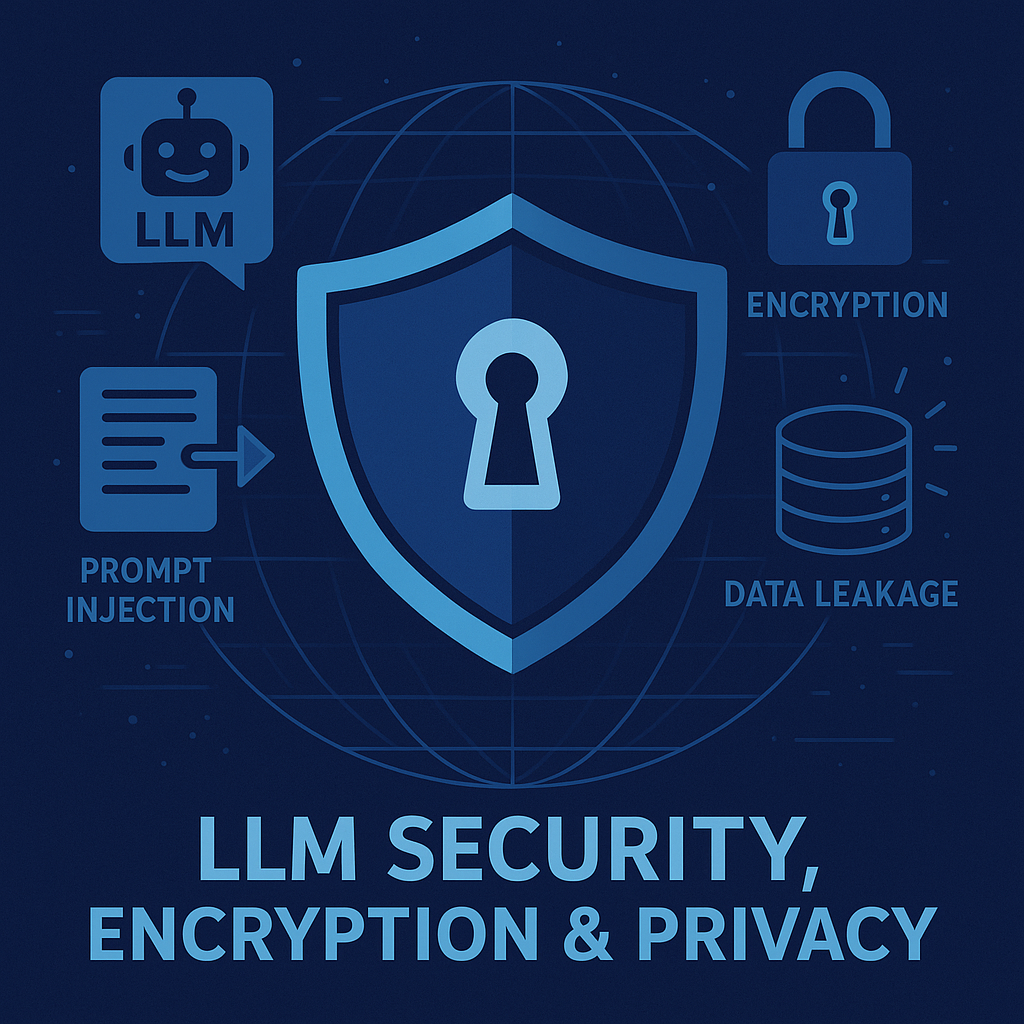
Prompt injection is a technique where malicious inputs are designed to manipulate the behaviour of LLMs. These attacks can bypass safety mechanisms, leading to unintended outputs. The Open Worldwide Application Security Project (OWASP) has identified prompt injection as a top security risk in its 2025 report, emphasizing the need for robust defenses against such exploits.
Data Leakage Risks
LLMs trained on vast datasets may inadvertently memorize and reproduce sensitive information. This can lead to unintended data leaks, compromising user privacy. Techniques like differential privacy aim to mitigate this risk by adding noise to the data, ensuring individual data points remain confidential.
Model Inversion Threats
Model inversion attacks involve extracting sensitive information from a model’s outputs. By analyzing the responses of an LLM, attackers can infer details about the data it was trained on. This underscores the importance of securing training data and implementing safeguards against such inference attacks.
Encryption Techniques for LLMs
Homomorphic Encryption
Homomorphic encryption allows computations to be performed on encrypted data without decrypting it. This ensures data privacy during processing. NYU researchers have demonstrated the feasibility of using homomorphic encryption for high-resolution object detection, showcasing its potential in privacy-preserving AI applications.
Attribute-Based Encryption
Attribute-based encryption provides fine-grained access control by allowing data to be encrypted based on user attributes. This ensures that only authorized users can access specific data, enhancing security in multi-user environments.
EmojiCrypt Method
EmojiCrypt is an innovative approach that uses emojis to encrypt user inputs before sending them to LLMs. This method ensures that sensitive information remains concealed, even from the service providers, without compromising the model’s performance.
Privacy-Preserving Mechanisms

Differential Privacy
Differential privacy adds statistical noise to data, ensuring that individual data points cannot be distinguished. This technique is crucial for protecting user privacy, especially when training LLMs on sensitive datasets.
Federated Learning
Federated learning allows models to be trained across multiple decentralized devices without sharing raw data. This approach ensures data remains on local devices, reducing the risk of centralized data breaches.
Confidential Computing
Confidential computing leverages hardware-based Trusted Execution Environments (TEEs) to process data securely. By ensuring that data remains encrypted during processing, TEEs provide an added layer of security for LLM operations.
Regulatory and Ethical Considerations
As LLMs become integral to various sectors, ensuring compliance with data protection regulations like the General Data Protection Regulation (GDPR) is paramount. Ethical considerations, such as preventing biases and ensuring transparency, are also critical. Organizations must adopt frameworks that prioritize both legal compliance and ethical responsibility in AI deployments.
Case Studies and Real-World Applications
NeurIPS 2024 LLM Privacy Challenge
The NeurIPS 2024 LLM Privacy Challenge aimed to identify vulnerabilities in LLMs and develop techniques to enhance their privacy. This initiative has spurred significant advancements in understanding and mitigating privacy risks associated with LLMs.
NYU’s FHE Object Detection
Researchers at NYU showcased the first-ever high-resolution object detection using Fully Homomorphic Encryption (FHE) with the YOLO-v1 model. This breakthrough demonstrates the potential of FHE in enabling secure AI computations without sacrificing performance.
OptIQ’s Data Privacy Solutions
OptIQ offers solutions that help organizations preserve data privacy in LLM applications. Their approaches include data localization, access control mechanisms, and compliance with global privacy laws, ensuring that sensitive data remains protected.
Future Directions in LLM Security
The future of LLM security lies in developing models that are inherently privacy-centric. This includes integrating advanced encryption techniques, adopting federated learning frameworks, and ensuring transparency in AI decision-making processes. Collaborative efforts between researchers, industry stakeholders, and policymakers will be crucial in shaping a secure and private AI landscape.
Frequently Asked Questions
1. What is prompt injection in LLMs?
Prompt injection involves crafting inputs that manipulate LLMs into producing unintended outputs, potentially bypassing safety mechanisms.
2. How does homomorphic encryption benefit LLMs?
Homomorphic encryption allows computations on encrypted data, ensuring data privacy during processing without the need for decryption.
3. What is federated learning?
Federated learning is a machine learning approach where models are trained across decentralized devices, ensuring that raw data remains local and private.
4. Why is differential privacy important?
Differential privacy adds noise to data, ensuring individual data points cannot be distinguished, thus protecting user privacy during data analysis.
5. How does EmojiCrypt work?
EmojiCrypt uses emojis to encrypt user inputs before sending them to LLMs, concealing sensitive information while maintaining model performance.
6. What are Trusted Execution Environments (TEEs)?
TEEs are secure areas within a processor that ensure data remains encrypted during processing, providing an added layer of security for sensitive computations.
Conclusion
As LLMs continue to permeate various facets of our digital lives, ensuring their security and privacy becomes increasingly critical. Through advancements in encryption techniques, privacy-preserving mechanisms, and a strong emphasis on ethical considerations, the path forward involves a collaborative effort to build AI systems that are both powerful and trustworthy.
References:
Originally published on Medium.