Masked Auto Encoders: When a Model Learns to See by Looking Away
Hide 75% of an image. Ask the model to imagine the rest. Somehow, that’s how it learns to see.
If you’ve spent any time around self-supervised vision, you’ve probably seen MAE dropped into a paper like everyone obviously knows why it works.

Here’s the one-line version that sounds broken:
Delete most of the image. Make the model paint it back. Keep the part of the model that learned to do it.
No labels. No captions. Just a brutal game of fill-in-the-blank. And it produces backbones that beat the “proper” supervised way of training.
Let me give you the actual intuition not just the diagram.
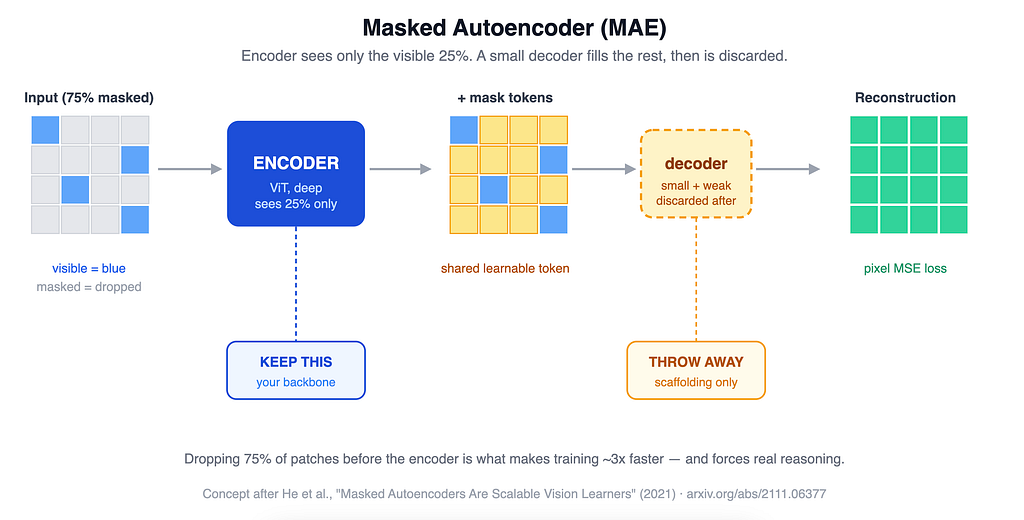
The asymmetric design at a glance , encoder sees only the visible patches, the weak decoder reconstructs the rest, and you keep just the encoder.
The Question Nobody Was Answering
NLP solved this years ago. BERT masks ~15% of the words in a sentence and predicts them. That one trick reshaped the field.
So the obvious question: Why didn’t the same trick just work for images?
People tried. It underperformed. For years, contrastive methods (SimCLR, MoCo, DINO) ruled vision instead , powerful, but fiddly. Heavy augmentations, huge batches, momentum encoders.
MAE’s real insight isn’t “mask patches.” Everyone knew that. It’s understanding why vision is different from language and redesigning around it.
Two ideas do all the work.
Idea 1: Images Are Lazy. Words Are Dense.
This is the whole paper. Slow down here.
- A word is high-information. Drop one : “The capital of France is ___” and recovering it needs actual understanding. You can’t fake it from the neighbours.
- A pixel is the opposite. Delete a patch of sky and you don’t need to understand anything. You just copy the blue from next door. Images are spatially redundant. Most of a patch is guessable from what’s around it.
So masking only 15% of an image sets a trivial task. The model becomes a good smudge tool and learns nothing about objects.
The fix is almost violent: Mask 75%.
- When three of every four patches are gone, copy from neighbours stops working. The holes are too big.
- To fill them, the model has to reason “that’s a dog’s leg, so the body continues here.”
- You’ve forced it to build a model of the world instead of a model of local texture.
- The masking ratio isn’t a knob you tune for two points. It is the mechanism.
- Low ratio → interpolation → no learning.
- High ratio → reasoning → representation.
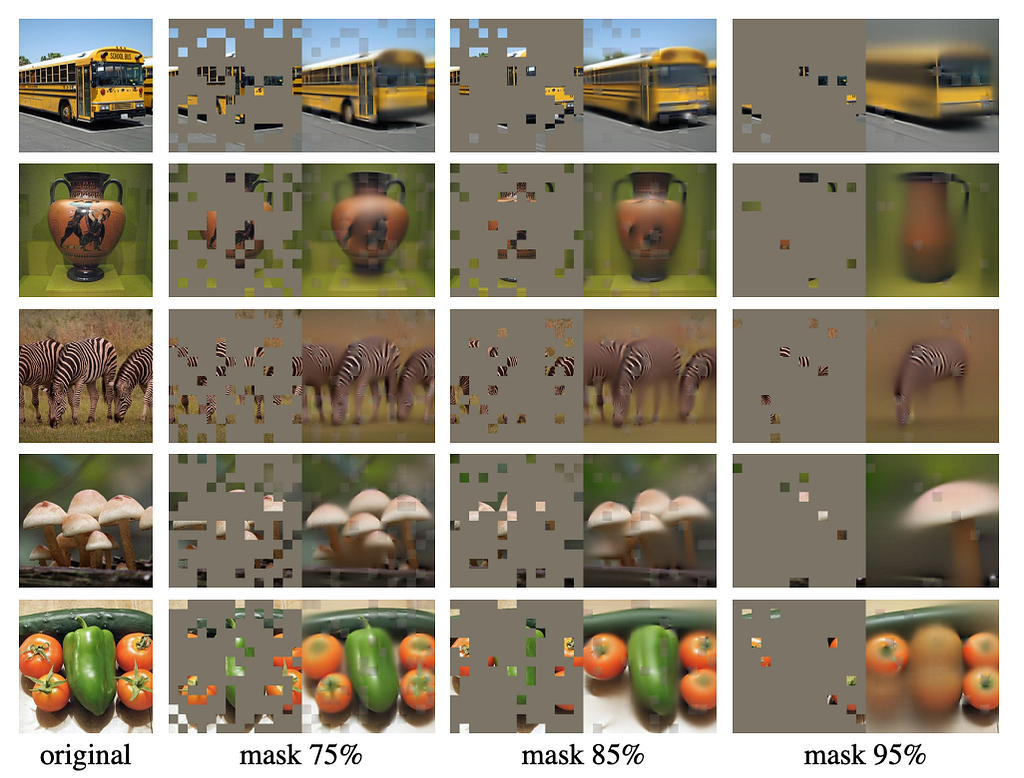
Masked input (left), MAE’s reconstruction (middle), original (right) filling 75% of the image from a quarter of the patches. Source: He et al., 2021.
Idea 2: The Asymmetric Encoder–Decoder (the Free Lunch)
Standard auto encoder: encoder compresses, decoder reconstructs. Symmetric. Balanced.
MAE breaks the symmetry on purpose.
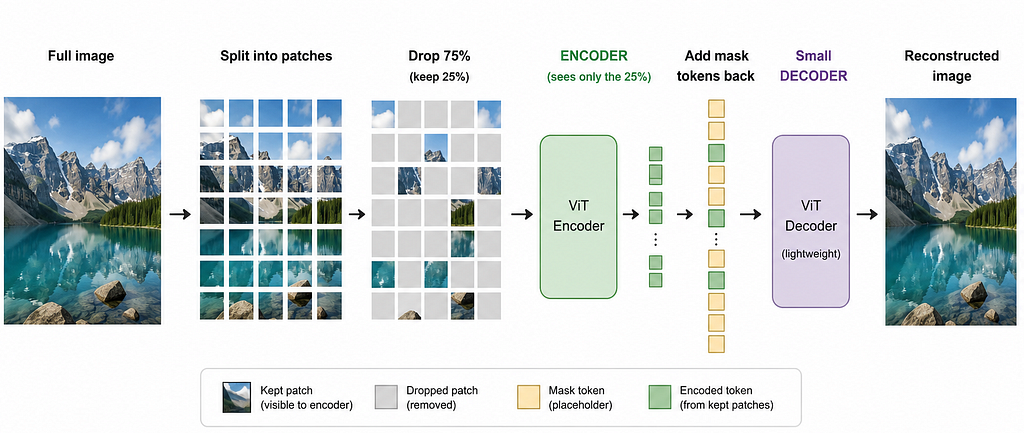
**The encoder only ever sees the visible patches.**Not the masked ones. Not even placeholders for them. If 75% is masked, the encoder processes 25% the rest are thrown away before the encoder runs.
Then a small decoder takes the encoded patches, drops in shared learnable mask tokens for the holes, adds positional info, and reconstructs the full image.
Sit with why this is beautiful
- Attention scales quadratically with sequence length.
- Drop 75% of patches and the encoder’s sequence shrinks to a quarter.
- Training gets ~3x faster and you can spend the savings on a bigger encoder. The same lever that creates the learning signal also pays the compute bill.
- The decoder is disposable. It exists only during pretraining. When you’re done, you throw it away and keep the encoder. You were never building an image generator just a feature extractor, with scaffolding.
- No train/inference gap. The encoder never saw mask tokens, so at downstream time, full, real images it’s exactly in distribution.
The Bit Everyone Skips: Why the Decoder Stays Weak
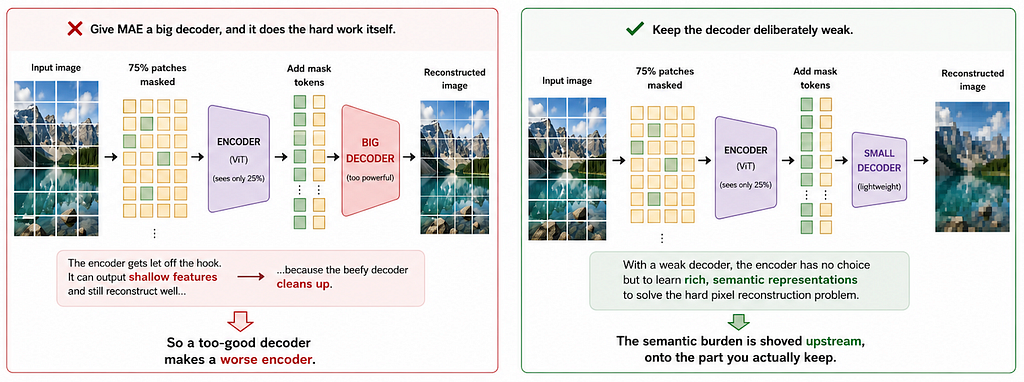
Most summaries say “lightweight decoder” and move on. Here’s the part worth catching.
In BERT, the decoder can be trivial because the output (a word) is already semantic. In vision, the output is pixels , about as low-level as it gets. And that’s a trap:
- Give MAE a big decoder, and it does the hard work itself.
- The encoder gets let off the hook it can output shallow features and still reconstruct well, because the beefy decoder cleans up.
- So a **too-good decoder makes a worse encoder.**You keep the decoder deliberately weak to shove the semantic burden upstream, onto the part you actually keep.
The general lesson and it shows up everywhere in self-supervised learning:
The model will always take the lazy path. Half of designing a good pretext task is closing off the cheap shortcuts.
Hold that thought. It shows up again at the domain level.
The Trade-Off (Because Nothing Is Free): One Place the Masking Task Quietly Goes Trivial
First, let’s kill a tempting over generalisation: “MAE only works on natural photos.” It doesn’t and the strongest evidence is medical imaging, about as far from ImageNet as you can get.
MAE pre-trained on the target medical set routinely beats ImageNet-pre-trained backbones across chest X-ray classification, CT segmentation, and MRI tumor segmentation.
The reason is exactly Idea 2’s context aggregation: anatomy is interconnected and irregular, so reconstructing a masked region forces real structural understanding. Same engine, different domain.
So the failure mode isn’t “non-natural images.” It’s much narrower: strong, global periodicity.
Remember why high masking works , it kills the copy from neighbors shortcut. That quietly assumes the image is non-periodic. On a strict repeating pattern a uniform textile weave, a regular grid, a periodic wafer surface masking stops being a hard puzzle even at 75%, because the pattern repeats.
To fill a hole, the model doesn’t reason; it copies the identical motif from one period over. The periodicity hands the shortcut right back.
The model then gets a low loss by becoming a great pattern-redrawing machine. It nails the periodic scaffolding — and the rare, aperiodic deviations (a defect, an anomaly) barely move the pixel-MSE needle, so it learns to ignore the very thing you cared about.
That’s the “lazy path” lesson, one level up. MAE assumes redundancy is the enemy it’s fighting. When your domain’s redundancy is globally periodic rather than the local, stochastic redundancy of natural or medical images, the pretext task can collapse into something trivial.
The practical tell: before trusting MAE on a new domain, ask whether the image is globally predictable from a single repeating unit. If it is, the masking task may be solvable without learning anything you want.
A Simple Mental Model
If a normal auto encoder is tracing a picture you can fully see, MAE is describing a room after glancing at a quarter of it , you’re forced to understand the room, not copy it.
Same image. Much harder game. Much better understanding.
So When Do You Actually Reach for MAE?
Good default when:
- You have lots of un-labeled, natural-ish images and want a transferable backbone.
- You’ll fine-tune the encoder (MAE shines fine-tuned; it’s weaker at frozen linear-probing than contrastive methods).
- You’re compute-conscious, the asymmetric design makes big-ViT pre-training cheaper.
- Downstream is dense , detection and segmentation, where pixel reconstruction teaches good spatial features.
Look elsewhere when:
- Images are strongly, globally periodic (the caveat above) , repeating weaves, grids, wafer surfaces , where the masking task can go trivial. Use block masking, a frequency-aware objective, or DINO-family features instead.
- You need great frozen, off-the-shelf features,DINOv2 tends to win.
- You have few un-labeled images, pre-training from scratch isn’t worth it; continued pre-training a strong existing backbone is the better middle path.
The question before any self-supervised run:
What’s the cheapest way for this model to lower its loss without learning what I want? If that path exists in your data, the pretext task is broken before it starts.
Final Thoughts

It’s easy to file MAE under “BERT, but for pictures.” That misses it.
The real idea was realising the trick doesn’t transfer without understanding why the medium is different. Language is dense, so mask a little. Vision is lazy, so mask a lot. Everything else , the asymmetric encoder, the deliberately weak decoder falls out of that one observation.
And the part that outlives the paper:
Good self-supervised learning isn’t a clever pretext task. It’s understanding your data well enough that the only easy solution is the one you wanted.
MAE did that for natural images , and it turns out, for medical scans, satellite tiles, and plenty of other domains nobody would call “natural.”
Whether it does it for yours comes down to one question: can the masking task be solved without understanding? On a strict repeating pattern, sometimes yes and sometimes No.
Mask most of the image. Force reasoning over interpolation. Throw away the decoder.
Keep what learned to see.
Original paper: He, Chen, Xie, Li, Dollár, Girshick — “Masked Autoencoders Are Scalable Vision Learners” (FAIR, 2021) — arxiv.org/abs/2111.06377*
I’m a Staff Machine Learning Engineer working at the intersection of ML infrastructure, computer vision, and large-scale data systems. I write about practical ML engineering, LLM infrastructure, and the systems thinking that makes AI work in production.
Originally published on Medium.