From Basics to Breakthroughs: The Complete Guide to GhostConvBlock in Deep Learning
Convolutional Neural Networks (CNNs) revolutionised image processing by mimicking how the human brain processes visual data. But as CNNs became deeper and more powerful, they also became heavier — slower and computationally expensive.
In a world moving towards mobile and embedded intelligence, we needed a smarter, leaner approach.
Enter: GhostConvBlock, the backbone of the GhostNet architecture.
This guide walks you through everything — from foundational concepts to advanced mechanics — so you understand not just how GhostConvBlock works, but why it matters.
🧱 The Basics: What Is a Convolution?
Convolutions are mathematical operations used in CNNs to detect features like edges, textures, or shapes in images.
A convolutional layer slides a small filter (e.g., 3×3) over an image and calculates a dot product between the filter and overlapping pixel regions. The output is a feature map.
Example:
If you feed an image of a cat into a CNN:
- The first layer might detect edges.
- The second layer might detect patterns like fur or whiskers.
- Deeper layers might identify eyes, ears, or even the concept of a “cat.”
But there’s a catch…
🤔 The Problem: Redundancy and Inefficiency
Standard convolution layers
- Are heavy in terms of parameters and computation.
- Repeat similar patterns across different filters.
- Struggle on devices with limited memory (e.g., phones, drones, IoT sensors).
Redundancy is the key issue. Many feature maps in a CNN look alike because multiple filters learn similar features.
So, why compute all these features from scratch when some can be “ghosted” or approximated from existing ones?
👻 Enter GhostConvBlock: The Efficient Alternative
✨ Key Idea:
Not all features need expensive convolution. Some can be generated from existing ones using lightweight operations.
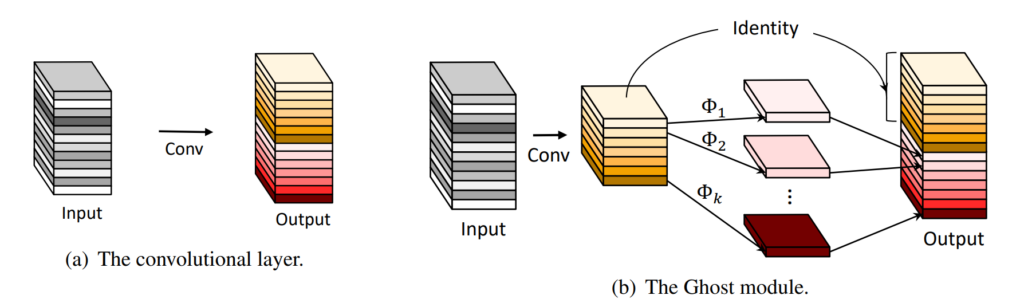
GhostConvBlock does exactly this:
- Creates a small set of core feature maps using regular convolution.
- Generates “ghost” feature maps using cheap linear operations (e.g., depthwise convolution).
- Combines both to form the final output.
🔍 Visual Breakdown of GhostConvBlock
Imagine GhostConvBlock as a two-part machine:
- Primary Convolution Uses a 1×1 convolution to produce C/r feature maps (where r is the ratio, typically 2).
- Ghost Module Each intrinsic feature map is passed through lightweight transformations to generate additional “ghost” features.
- Concatenation Both sets are merged to form the output of C channels.
[Input] ↓[1×1 Conv → Intrinsic Features] ↓[Cheap Operations → Ghost Features] ↓[Concat → Full Output]🔢 Let’s Talk Numbers
Assume:
- You need to produce 64 feature maps.
- Instead of using a standard conv that outputs all 64,
- GhostConvBlock
- Produces 32 maps via regular conv
Generates the remaining 32 using cheap operations
🔽 Result:
- Fewer parameters
- Lower computational cost (FLOPs)
- Faster inference
📊 Standard Conv vs. GhostConvBlock
Feature Standard Conv GhostConvBlockFLOPs High Low (up to 70% reduced)Parameters High FewerSpeed on Mobile Slow FastAccuracy (Top-1) Slightly higher Comparable (≤1% diff)Memory Usage High Optimized🔧 Under the Hood: Code for GhostModule in PyTorch
Here’s a working implementation in PyTorch:
class GhostModule(nn.Module): def __init__(self, inp, oup, ratio=2, dw_size=3, relu=True): super(GhostModule, self).__init__() init_channels = math.ceil(oup / ratio) new_channels = init_channels * (ratio - 1) self.primary_conv = nn.Sequential( nn.Conv2d(inp, init_channels, 1, 1, 0, bias=False), nn.BatchNorm2d(init_channels), nn.ReLU(inplace=True) if relu else nn.Identity() ) self.cheap_operation = nn.Sequential( nn.Conv2d(init_channels, new_channels, dw_size, 1, dw_size//2, groups=init_channels, bias=False), nn.BatchNorm2d(new_channels), nn.ReLU(inplace=True) if relu else nn.Identity() ) def forward(self, x): x1 = self.primary_conv(x) x2 = self.cheap_operation(x1) return torch.cat([x1, x2], dim=1)[:, :self.primary_conv[0].out_channels * 2]🧪 Real-World Use Cases
GhostConvBlock powers:
- GhostNet: An ultra-light CNN for mobile devices.
- YOLOv5-Ghost: A variant of the popular object detection model using Ghost modules.
- Medical Imaging Models: Lightweight analysis on portable ultrasound or X-ray devices.
🚀 Going Advanced: GhostNetV2
GhostNetV2 introduced Dynamic Feature Calibration (DFC), which helps the model:
- Focus on important features.
- Suppress irrelevant noise.
- Boost accuracy without increasing model size.
Think of DFC as giving your network a pair of glasses — it sees what matters more clearly.
🛠 Best Practices
- Use GhostConvBlock in mid to deep layers where redundancy is higher.
- Avoid it in early layers that need high-resolution detail extraction.
- Combine with attention blocks (e.g., SE block) for better feature tuning.
- Always benchmark your changes — performance can vary by task.
🧠 Final Thoughts
GhostConvBlock is more than just a clever trick — it’s a paradigm shift. It challenges the status quo of deep learning by asking: Do we really need to compute everything?
If you’re building AI for:
- Phones
- IoT devices
- Robots
- Drones
…you should definitely look into GhostConvBlock. It’s how we bring deep learning to the real world.
📚 References
- Han, K. et al. GhostNet: More Features From Cheap Operations, CVPR 2020
📄 https://arxiv.org/abs/1911.11907 - Han, K. et al. GhostNetV2: Enhance Cheap Operation with Long-Range Attention, 2022
📄 https://arxiv.org/pdf/2211.12905 - GhostNet Official Code:
🔗 https://github.com/huawei-noah/ghostnet
💬 Enjoyed the read? Follow for more deep dives into efficient AI design, practical neural networks, and production-ready model architectures.
Originally published on Medium.