DilatedConvBlock: When Convolutions Learn to Breathe
If you’ve spent any time reading deep learning papers, you’ve probably seen dilated convolutions casually dropped in like everyone obviously knows what they are.
A DilatedConvBlock is not some exotic neural network spell. It’s simply a convolutional block that uses dilated (also called atrous) convolutions, usually combined with normalization and an activation function.
Its superpower?
Seeing more context without doing more computation.
The Core Idea (No Magic, Just Math)
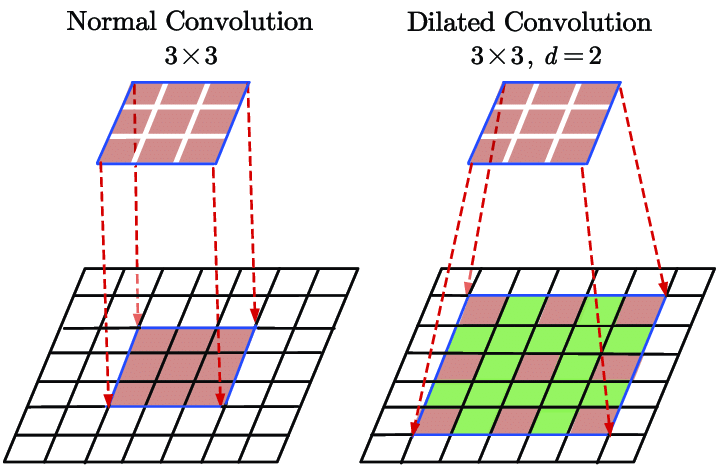
In a standard convolution, a kernel slides over an input and looks at neighbouring values.
A 3×3 kernel sees exactly a 3×3 area. Straightforward.
A dilated convolution spreads those same kernel values apart.
Instead of looking like this:
X X XX X XX X XIt looks more like this (dilation rate = 2):
X . X . X. . . . .X . X . X. . . . .X . X . XKey point:
- Same kernel size
- Same number of parameters
- Much larger receptive field
That’s the entire trick.
So What Is a DilatedConvBlock?
A DilatedConvBlock usually bundles a few standard layers together:
Dilated Convolution
- Kernel size (often 3×3)
- Dilation rate > 1
- Padding adjusted to preserve spatial size
Normalization
BatchNorm, LayerNorm, or GroupNorm
Keeps training stable and sane
Activation
ReLU, GELU, SiLU — pick your favorite
Sometimes you’ll also see:
Dropout (to reduce overfitting)
Residual connections (to keep gradients happy)
Conceptually:
Input → Dilated Convolution → Normalization → Activation → OutputNo mystery. Just good engineering.
Why Not Just Use Bigger Kernels?
You could increase kernel size, but that comes at a cost:
- More parameters
- More computation
- Higher risk of overfitting
Dilated convolutions avoid all that:
- No extra parameters
- Wider context
- Better efficiency
It’s like upgrading your vision without upgrading your hardware.
Where DilatedConvBlocks Shine
DilatedConvBlocks are especially useful when context matters more than local detail.
Semantic Segmentation
Pixel-level tasks need both detail and global awareness. Dilated blocks let the model understand the scene without downsampling.
Time-Series and Audio
Dilations help capture long-range dependencies without stacking dozens of layers. This is why architectures like WaveNet rely on them.
Dense Prediction Tasks
Medical imaging, depth estimation, satellite imagery — anywhere resolution and context need to coexist.
The Trade-Off (Because Nothing Is Free)
Dilated convolutions can introduce gridding artifacts, especially when using large dilation rates repeatedly.
Common fixes include:
- Mixing different dilation rates
- Combining normal and dilated convolutions
- Using multi-scale feature fusion
Rule of thumb: dilate responsibly.
A Simple Mental Model
If regular convolution is reading a sentence word by word,
dilated convolution is speed-reading while still understanding the paragraph.
Same effort. Bigger picture.
Final Thoughts
A DilatedConvBlock isn’t flashy. It won’t dominate conference headlines. But it solves a real problem:
How do we increase context without increasing cost?
Quietly, efficiently, and elegantly.
If your model needs to see more of the world without becoming slower or heavier, a DilatedConvBlock might be exactly what you’re looking for.
Originally published on Medium.