DataTrove: The Factory Floor Behind Every Good LLM
How Hugging Face turned the chaos of web-scale data processing into composable, production-grade Lego blocks and why every ML engineer building LLMs should care.
Everyone obsesses over model architecture. Attention heads, mixture-of-experts, KV-cache optimizations these dominate the discourse. But here’s what I’ve learned after years of building ML systems at scale , the model is only as good as the data pipeline that feeds it.
And that pipeline? It’s usually a nightmare. A tangled mess of bash scripts, one-off Python files, undocumented heuristics, and someone’s “temporary” Jupyter notebook that’s been running in production for eight months.
Hugging Face clearly felt this pain too. Their answer DataTrove an open-source library that turns raw web-scale data processing into something that actually resembles engineering.
Let me break down why this matters, what the library actually does under the hood, and how you can think about it if you’re building (or planning to build) LLM training pipelines.
The Problem DataTrove Solves (And Why It’s Harder Than You Think)
Let’s set the stage with a real number: FineWeb, Hugging Face’s flagship pre-training dataset, contains over 15 trillion tokens. It was processed from 96 CommonCrawl dumps spanning 2013 to 2024. FineWeb2, its multilingual successor, covers dozens of languages across roughly 20 terabytes and 5 billion documents.
Now ask yourself, how would you build the pipeline to create this?

You’d need to download and parse WARC files (raw web crawl archives), extract readable text from HTML, filter out garbage (boilerplate, spam, low-quality pages), deduplicate at multiple levels (exact, near-duplicate, sentence-level), handle PII, tokenize, and write the results in a format your training loop can consume all while running across hundreds of nodes on a Slurm cluster, tracking failures, and being able to resume from exactly where you left off.

This isn’t a data engineering problem you solve with Spark and call it a day.
The filtering heuristics alone Gopher quality filters, C4 filters, language detection, repetition analysis are domain-specific to NLP and deeply intertwined with downstream model performance.
DataTrove is the library that Hugging Face built to do all of this. And then they open-sourced it.
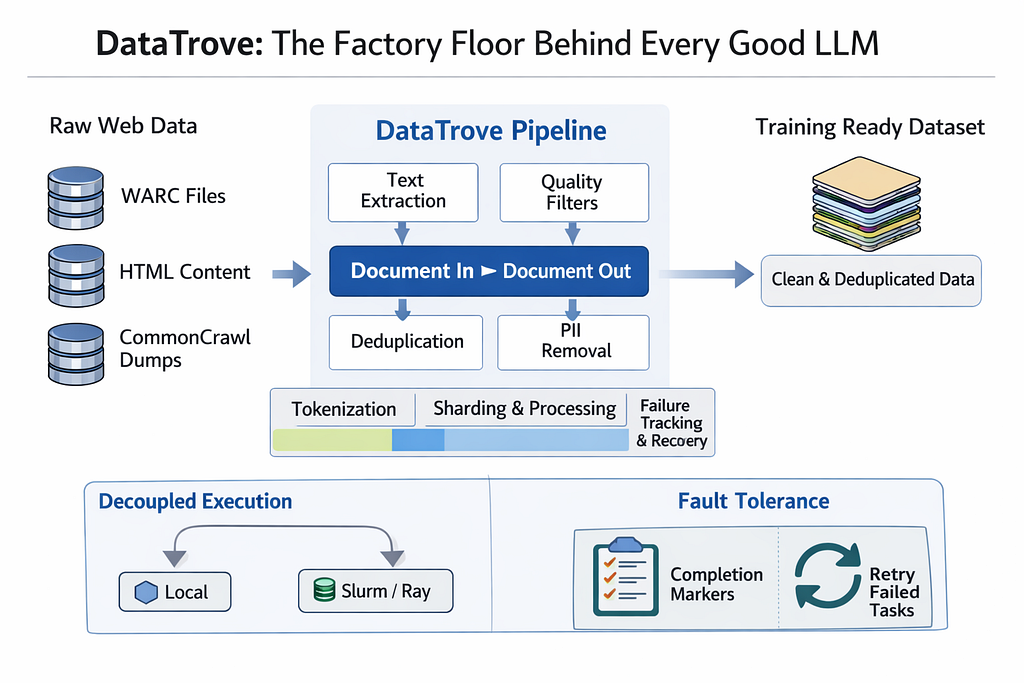
The Core Mental Model: Documents In, Documents Out
Here’s where the design gets elegant. DataTrove operates on a single abstraction: the Document. Every document has three fields ‘text’, ‘id’, and ‘metadata’. That’s it.
Every processing block in DataTrove takes a generator of Documents as input and yields a generator of Documents as output. This is the Unix philosophy applied to data processing: each block does one thing, and you compose them into pipelines.
The Execution Model: Same Pipeline, Any Infrastructure
This is where DataTrove makes a sharp architectural decision that I particularly appreciate as an ML engineer the pipeline definition is completely decoupled from execution.
You define what to do (the pipeline), and then separately decide where to run it (the executor). Same pipeline, zero code changes, different environments.This is the kind of separation-of-concerns that makes systems actually maintainable when you’re processing petabytes.
Fault Tolerance That Actually Works
Here’s a detail that matters enormously at scale and that most people gloss over: DataTrove tracks task completion using marker files.
When a task finishes successfully, it drops an empty file in a `completions/` directory. If your job crashes (and at 5,000 tasks across hundreds of nodes, something will crash), you just re-launch the exact same executor. DataTrove detects which tasks already completed and only re-runs the failures.
No external state store. No database. No Redis. Just filesystem markers. It’s beautifully simple and it works with any storage backend (local, S3, GCS) via ‘fsspec’.
The one rule: don’t change the total number of tasks between re-runs, because task count determines how input files are sharded across workers.
The Deduplication Story: Where the Real Value Lives

If I had to pick the single most impactful component in DataTrove, it would be the **deduplication pipeline.**This is where dataset quality is won or lost.
DataTrove supports multiple dedup strategies:
MinHash deduplication the workhorse : Generates locality-sensitive hash signatures, buckets similar documents, clusters them, and filters duplicates. This is what FineWeb uses, and it runs across three separate pipeline stages (signature → bucket → cluster → filter), each of which can be independently parallelized.
Sentence-level exact dedup : Removes duplicated sentences across documents, useful for boilerplate headers/footers that MinHash might miss.
Exact substring dedup : For cases where you need byte-level precision.
The MinHash implementation is particularly well-engineered. The config is separated into a ‘MinhashConfig’ object, the bucketing stage can parallelize across hash bands, and the whole thing is designed to be run as chained Slurm jobs with dependency management.
An insight from the FineWeb paper that surprised me: deduplicating each CommonCrawl dump individually actually outperformed deduplicating the entire corpus at once.
The reason likely comes down to temporal distribution different crawl snapshots capture different states of the web, and treating them independently preserves that diversity.
Built-in Quality Filters: Standing on the Shoulders of Research
DataTrove doesn’t just give you plumbing it ships the actual quality heuristics that have been validated through research:
- GopherQualityFilter : Based on DeepMind’s Gopher paper. Checks word count, mean word length, symbol-to-word ratios, and other statistical properties.
- GopherRepetitionFilter : Catches documents with excessive n-gram repetition (a surprisingly common problem in web data).
- C4QualityFilter : Filters from Google’s C4 dataset, including sentence-ending punctuation checks and “dirty word” filtering.
- FineWebQualityFilter : Hugging Face’s own additions that pushed FineWeb’s quality above RefinedWeb.
- LanguageFilter : Language identification to isolate specific languages.
- URLFilter : Domain and URL pattern-based filtering.
Each filter can also write rejected documents to an `exclusion_writer`, so you can inspect what’s being removed and tune your filtering pipeline empirically. This is a critical design choice blindly throwing away data without visibility is how you accidentally filter out entire domains or topics.
Why This Matters Beyond FineWeb
Here’s my take on why DataTrove deserves more attention in the ML engineering community:
1. It makes LLM data work reproducible.
The FineWeb processing script is literally a single Python file in the DataTrove examples directory. Anyone can read it, understand the exact filtering and dedup steps, and reproduce or modify the dataset. Compare this to the “we applied proprietary filtering” statements in most model papers.
2. It’s a forcing function for data engineering rigor.
The pipeline/executor separation, the fault tolerance model, the per-task logging and statistics these are patterns from mature data engineering, applied to an area (LLM data prep) that’s historically been held together with duct tape.
**3. It lowers the barrier to custom pre-training datasets.
**If you’re training a domain-specific LLM (legal, medical, semiconductor, you name it), you need to build a custom data pipeline. DataTrove gives you the scaffolding so you can focus on your domain-specific logic rather than reinventing file sharding and dedup from scratch.
**4. The modular design invites experimentation.
**Want to test whether a new quality filter improves downstream performance? Slot it into the pipeline, run it, compare the stats. The composability makes ablation studies on data processing steps practical.
Final Thoughts
The LLM world talks a lot about scaling laws for compute. But there’s an equally important scaling law for data, the quality of your training data compounds through every gradient update. A bad data pipeline doesn’t just waste tokens it actively degrades the model.
DataTrove represents something I think we’ll see more of in the ML ecosystem , infrastructure that treats data processing as a first-class engineering discipline, not an afterthought you hack together before the “real work” of training begins.
If you’re an ML engineer working anywhere near LLM pre-training, fine-tuning datasets, or large-scale text processing spend an afternoon with DataTrove. Read the FineWeb example script. Understand the pipeline blocks. You’ll walk away with a much sharper mental model of what goes into the data behind every frontier model.
The factory floor isn’t glamorous. But it’s where quality is built.
Find the DataTrove repository here: github.com/huggingface/datatrove
Originally published on Medium.